

When is (language) learning no longer sexy?
Luxury, privilege, and the lack of in education

The other day, my girlfriend and I walked a few blocks over from our place to visit a family friend and, more importantly, her very round and friendly cat. When we entered, we exchanged pleasantries, kicked off our shoes at the door, and left our coats at the edge of the couch. My girlfriend and the woman launched into casual conversation about life, the cat (of course), working life, etc. and I followed along fairly well, forcibly pulling my one year of language learning into use and trying to link everything together the best I could. The woman asked me about my studies and I told her they were going well and that I was interning right now (stuttering on the word intern, but continuing on anyway). She asked me in a low, quick voice if I had been berry picking yet – poimia marjoja – which I didn’t understand. I turned to my girlfriend to ask her with my eyes what that meant, but the woman interrupted, telling me only Finnish! before I could get the new phrase. Both of us were immediately irritated, but we continued politely and I eventually answered no, not yet.
Quickly, it became clear that the evening would continue this way. When speaking to me, the woman never slowed her speech at all, spoke extra clear, or avoided more complex vocabulary, and when it became obvious that I didn’t understand, she kept pushing me until I was entirely overwhelmed and felt stupid, despite thinking later on that I did quite well given my current A2/B1 level in the language. I became so flustered and felt so purposely humiliated that I went to the bathroom to cry, exhausted from her and two other people from my work who seem incapable of giving me any support or leeway, or even basic respect and decency. While I was gone, my girlfriend informed her politely that I had already been dealing with these other women from work, and that I didn’t “need to hear more Finnish” because I live in Finland. I also, obviously, have a Finnish girlfriend to practice with often. When I came back, clearly not understanding the humiliation aspect, the woman confronted me about it, switching to English for the first time to tell me that she didn’t mean to hurt my feelings, but still saying (joking? I don’t know) that I should be fluent the next time I come over.
Clearly, I will not be coming over any time soon.
This experience and the experience with the people at my job who complain to my face about having to speak English with me, despite me being hired to speak English, has unfortunately put a damper on my drive to learn the language. The spectrum of responses to language learners is so wide that it becomes completely irrational; I had a person genuinely tell me “wow, good job!” at being able to say “thank you”, and then at the same time, I have people implying that I should be fluent after one year and a few months of studying the language - and one that is extremely different from English and the other languages I know or am familiar with at all. It’s an overwhelming experience and has made me extremely touchy to comments on my language skills, both positive and negative.
Demeaning comments, even those that are meant positively, have warped my understanding of learning and how learning is treated in different contexts. Previously, I have envisioned language learning as a privilege, something to be done in vast libraries, warm coffee shops, at home in the dark with a frenzied drive to communicate with another set of people. I still agree that language learning is a privilege in many ways – being a student right now, I am able to take language courses for no extra cost and I also have the time and energy to devote to it, which I wouldn’t if I had family to rely on me or if I was working an extra job. Because of this, and my status as a white student from the Global North, I have a different experience from many others. But still, as an immigrant, and with people telling me all the time that I have to be studying (which I am?!), I’m currently experiencing a weird in-between of sexy and unsexy learning. Let’s dive a bit into sexy learning:
Sexy learning is easily romanticized and puts little pressure on the student. Think dark academic tumblr pages, expensive coffees drank while studying, notes in beautiful handwriting. Think the phrase “disgustingly educated” that keeps showing up in various forms across the internet, and especially places like substack:
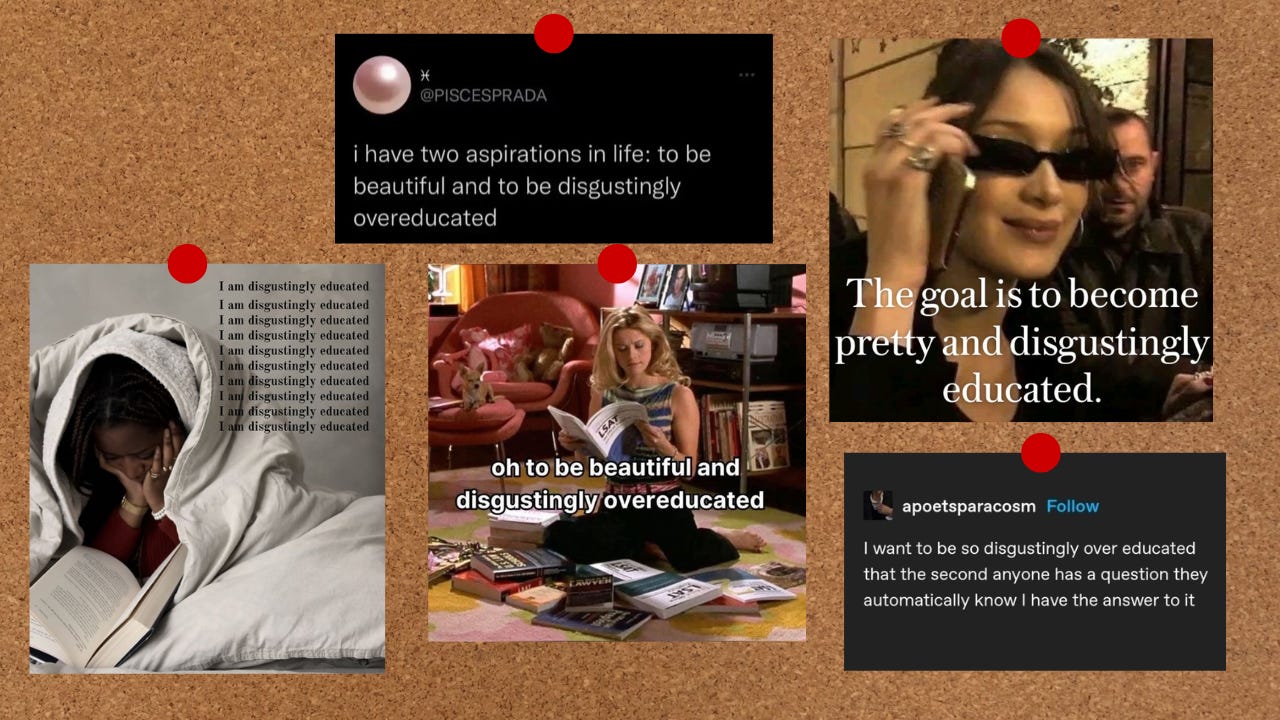
This genre of romanticization meshes well with that of the “grind” mindset, pushing viewers to study harder and become smarter in an individualistic way. The goal of education here is not to bring something to society, but to create a caricature of the wealthy, educated individual – primarily, the wealthy, educated woman. As you see in the pictures above, being educated is tied to beauty in this rhetoric, either through explicit mention (“oh to be beautiful!”) or through pictures of skinny, stylish women, even well-known models. But where do the rest of us fall when we don’t fit into these images of ideal education and intelligence? And what about the majority of us who don’t fall into this category because of our life experience and personhood - people of color, not conventionally attractive people, and people who don’t study as a “privilege” as these photos say, but because we need it to survive?
And I don’t mean to say that education isn’t a privilege, but there is a lot of nuance needed to the subject. I’m lucky enough to study something I want to study, not something that I hate that will bring me the most money, because I don’t have family relying on me for financial support. This is a privilege. It’s also true that there are so many people across the world that don’t have access to education, especially women and girls, and this should be thought of as perhaps too many of us take our education for granted. At the same time, education is a tool for survival. Education can be a privilege the way food is a privilege, in the way that we need it to live, but have to recognize that not everyone has access to food or the same quality of it. There is a scale of privilege regarding education, and the aesthetic of sexy learning is an extreme. For the rest of us, as much as we try to make our lives and our studies feel beautiful, they don’t always feel so. It’s hard to try to imagine something that we need to do to survive as “aesthetic” and pinterest-worthy. I can walk on beautiful cobblestone streets and drink perfect lattes and wear stunning clothes, but that doesn’t mean that learning something I am forced to know to live and work is beautiful in return. More succinctly, the struggle is not always beautiful. I am not always beautiful.
For immigrants in particular, especially those like me that need to learn a new language, language learning is tied to assimilation. When perfect language skills equate to perfect assimilation, learning the national language becomes a type of pain, an erasure of self. I recently spoke to a woman from Mexico who immigrated to Finland a few years ago and she warned me of making sure not to lose myself here, to become too caught up with melting into society. As I approach living in this country for a year and a half, this feeling has finally reached me. As much as I want to be able to speak fluently and without stress, the simultaneous feelings of inclusion and exclusion hits me again and again. The experience of being a Finnish learner is perhaps a bit different than some other languages too in that, despite a very complex grammar system, the slightest mistakes are very pronounced and immediately mark you as “foreign”.1 At least in my experience (as a native English speaker), English can be maneuvered more casually. There are so many dialects of English that a mistake is not necessarily assumed to be a mistake. In English-speaking countries as well, everyone is assumed to speak English - which is both positive and negative. There is little space for assistance in learning English, but there is also to some degree an understanding that we are the same. Language isn’t as dividing because we already are speaking the lingua franca, for better or worse. In Finland though, when I can’t hear a cashier and say excuse me?, they hear my accent and switch to English, even though I would know how to respond in Finnish. It’s meant to be helpful of course, but is dividing. The level of perfection needed clearly divides the Finnish from the immigrants, regardless of how hard we work.

Political decisions and attitudes also change the way we do or do not experience learning as a privilege. Anti-immigrant sentiment makes language learning a stressful requirement, not a luxury the way we want it to be. It is not education for reward, but education to avoid punishment. In much of Europe, anti-immigrant sentiment is on the rise.2 In Finland specifically, the far-right has proposed changing the constitution in order to alleviate unemployment benefits for immigrants unless they know Finnish or Swedish (both national languages).3 This is based on xenophobia, racism, and, in particular, Islamophobia. Assimilation is the truest marker of acceptability - and those who come from more similar cultures and “look the part” as white Europeans can get away with so much more. The only thing I need to do to be seen as native is to keep my mouth shut, whereas Finnish people of color and those with visible cultural differences like veiled women, are seen as foreign, even if they were born and raised here and know the language natively.
One and a half years into living here, I finally see the reason that so many immigrants don’t learn the language or don’t go beyond the basics. Being forced to learn kills our natural urge to be curious. I fight with myself constantly on my drive to learn the language; it is genuinely extremely important to me because of my partner, and I do naturally enjoy language learning. At the same time, when both politicians and individuals in my life are telling me to learn the language, I want to rebel because I already am working hard and it hurts to be not just unrecognized, but punished despite my work. I don’t want to be sucked into the immigrant assimilation pipeline either. I know the goods and bads of both my home culture and my adopted culture, and I like being able to combine them into my personal life, just like how I am able to combine two languages to move throughout my everyday.
In some ways, it’s a privilege to be caught between the two realms of learning, sexy and unsexy, because I still can romanticize my journey to make it fun and exciting sometimes, while those more marginalized than me are completely excluded from the feeling of luxury in their education. I also don’t think it’s a bad thing for people to romanticize education in this way - but we must recognize who is excluded, both purposefully and accidentally. We shouldn’t be viewing education as an individual lack to be overcome or a method of pulling oneself up by the bootstraps, but something more communal for a better society and to help people get the skills they need without the threat of losing access to welfare, citizenship, or even just social connections. In many ways, the beautiful aesthetic of education is a way to foster curiosity, to make learning fun, but how can we make this available for everyone?
My other main reference for this is speaking German in Austria, where no one ever pointed me out for not being fluent. If you have experience in this, please let me know, I’d love to hear about it!
this is such an interesting article!! really fascinating to hear about the language expectations in Finland. I don’t live in Poland but from experiences I’ve had working there, people are amazed that expats can speak even beginner Polish, because they see the difficulty in their own language and people can get around so easily in English. Generally, they’re very impressed and encouraging, and I hadn’t considered how language-learning could feel in Finland or countries that are less encouraging. I’ve always been so embarrassed by English people in my own country and their comparative lack of grace towards those who don’t speak it. I loved how you talked about education as a privilege and the connection between language-learning and identity!
I relate to a lot of this, especially the annoyance of being spoken to in English when I just didn't hear the first time! Although I think most people (in Madrid anyway) are just trying to be helpful. But we are in a lucky position that if we don't understand, many people can switch to English. I feel for immigrants in English-speaking countries trying to learn the language, it must be so isolating. I'm sorry you've had bad experiences, it really does take away from the good parts of language learning!